CASE 001 · Oregaonna
Chapter 1: The Voice They Knew
“I’d like to speak with Mr. Takahashi in Sales.”
“This is Takahashi speaking.”
On the other end of the line, the sound of turning pages stopped.
“Sorry—I mean the gentleman who usually handles our account.”
The client’s estimate was open on my monitor. The person in charge was listed as Naoto Takahashi. The company had used the same form for seven years, and for some reason my name always sat a little too far to the right.
“That’s me. Is this about the estimate I sent yesterday for the fall catalog?”
“Oh. I’m sorry. Your voice sounded different.”
“My throat’s been acting up.”
After I said it, I swallowed. Nothing hurt.
The client moved straight back to business. They wanted to know how much it would cost to add pages while keeping the same paper stock as last year. I opened the previous year’s specifications.
“The cover stock changed midway through last year’s job. It’s heavier than the stock in the original estimate, so I’ll recalculate using the final specifications.”
“Right, that’s true. You have a good memory.”
That change had added three extra rounds of phone calls with the print floor. Forgetting it would have been harder.
I promised a revised estimate by noon and ended the call.
Miyamoto, at the desk beside mine, looked over.
“Is your throat okay?”
“I’m fine. I need to fix this estimate first.”
She looked as if she might say something else, then turned back to her screen.
It was 10:17 a.m. Four emails needed replies. I had promised one of them an answer first thing that morning. I opened the costing sheet and changed the paper specification. The boxes where the numbers went were exactly where they had always been.
I sent the revised estimate before lunch and went outside for my break. Two vending machines stood behind the office. I normally bought canned coffee, but as I reached for my wallet, I remembered that I had just told someone my throat was bad. I chose water instead.
I took two swallows. It was only cold.
After checking that no one was coming through the back door, I opened the voice recorder on my phone.
“This is Takahashi from Saegusa Printing. Thank you as always for your business.”
When I played it back, a painfully polite voice came from the tiny speaker.
I had never liked hearing myself in recordings, but this was different. The small pause before “Takahashi” was mine. The habit of lowering my voice at the end of a sentence was mine. The pitch did not belong with either of them.
With my fingers against my throat, I tried again, forcing the words a little lower. My breath caught halfway through. I did not need to play it back to know how strained it had sounded.
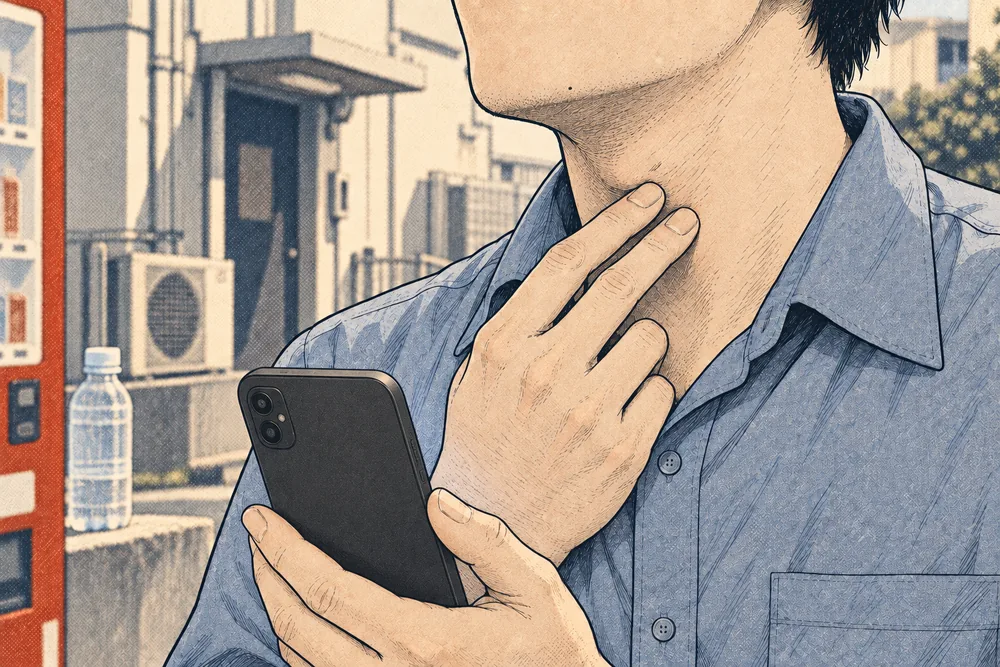
When I closed the recorder, I saw a message from Saeki.
Saturday, same time?
We played games together on weekends. I replied, Sure.
Back at my desk, I found the catalog production schedule lying beside my keyboard. Miyamoto must have printed it for me. The September delivery date was circled. Between April and that circle in September, most of the schedule was still blank. My name appeared again in the person-in-charge field below it.
I was about to delete the recording. Instead, I renamed the file “Voice” and added the date.
On the way home, I stopped at the drugstore by the station and bought three kinds of throat lozenges: honey, quince, and one with a long herbal name. When I told the cashier I did not need a bag, they looked up at my face for a second.
My ground-floor apartment was a twelve-minute walk from the station. From the front door, it was fewer than ten steps past the kitchenette to the main room, a compact space measuring six tatami mats. My jacket from that morning hung over the desk chair. Unfolded laundry sat at the foot of the bed.
I reheated frozen rice and ate it with leftovers. Then I tried the lozenges one by one. After the third, nothing felt different. I decided the brands were probably no good.
In the bathroom, I took off my glasses and leaned toward the mirror. A faint mark sat between my eyebrows. Slightly heavy eyelids, a round nose, a missed patch of stubble on my chin. It was the familiar sequence of checking a tired version of myself.
“Ah.”
The mouth in the mirror opened. The sound still came from somewhere slightly too high.
I touched my throat.
My fingertip slid down from beneath my chin and found my Adam’s apple in its usual place. It was there. The edges were simply rounder. When I swallowed, the hard shape that should have risen beneath my finger moved weakly, as if I were touching it through a thin layer of cloth. I wondered whether it had always been this soft. I had never had a reason to test the hardness of my own Adam’s apple before.
I said “ah” again and gradually lowered the note, keeping my fingers against my throat. At the pitch where the vibration normally reached my chest, it remained trapped near the top of my throat. The resonance had moved up a level. It felt as if the pipe carrying the sound had become a little shorter.
I moved my hand to my cheek. My chin, shaved that morning, was still smooth. By evening it was usually rough as sandpaper. Tonight, only the one missed hair stood out beneath my fingertip.
Before bed, I tried to turn off the lights by speaking to the smart speaker on my desk, the way I always did.
Its blue ring flashed once. “Sorry, I didn’t understand that.”
The second attempt got the same response. On the third, I pushed out my chest and forced my voice lower. At last, the lights went out.
I stood in the dark for a while. The previous winter, I had come home drunk and given the same command, and the speaker had still recognized me.
In bed, I searched my symptoms on my phone.
My finger stopped when “Feminization Syndrome” appeared among the suggestions. I remembered hearing the name in a workplace training session. I knew only that it was an illness affecting a limited age range. There had also been a television segment about programs helping patients return to work.
Twenty to forty-five.
At twenty-nine, I fell neatly in the middle.
The page said a change in voice alone was not enough for a diagnosis. I read that line several times. The next section discussed visible physical changes, but before I reached it, I opened one of the related search results.
It was a patient forum. I clicked a thread titled, Did anyone else start with their voice? and kept scrolling through the replies. An office worker in his thirties. A shop owner in his forties. During the first week, all of them had assumed it was a cold. Several had tried one throat lozenge after another.
By the time I noticed the hour, it was past two in the morning.
I deleted my search history. Then I closed every open tab as well. There was no one else in the apartment who could have seen them.
The next morning, I got ready in the usual order. I put the kettle on, placed bread in the toaster, and washed my face while it browned. As I brushed my teeth, I played a video about training a deeper voice.
“Imagine the sound resonating in your chest rather than your throat.”
The man in the video placed a hand on his chest and produced a rich, carrying note. I put a hand on mine and followed his instructions. The vibration stayed high in my throat. I stopped after three minutes.
The phone rang while I was buttering my toast. It was my manager.
“Takahashi, the client wants to push today’s visit back by thirty minutes. If you go straight there, can you still make it?”
“Yes. Ten-thirty, right?”
“...Right. Sorry, did I wake you?”
“I’m awake.”
He confirmed the time and hung up. I had been waiting for him to say something about my voice, and for several seconds I kept holding my empty hand against my ear as if the phone were still there.
I finished my coffee and chose a white shirt instead of the blue one. I fastened the top button, felt a slight pressure, and undid it. I had nothing to compare it with. Either the fabric had changed or my neck had.
At the client’s office, the contact looked directly at my face and greeted me normally.
I felt an enormous relief at that alone.
Whenever my voice rose during the meeting, I covered it with a cough, but no one commented. The revised copy they handed me on the way out weighed exactly the same as always.
When I returned to the office, Miyamoto pointed toward an empty conference room.
“You can use that for the online meeting this afternoon. You won’t have to project your voice.”
“Does it sound that strange?”
“It sounds different. Like you’re forcing it lower.”
I pushed my glasses up, feeling as though she had seen through me.
“I can’t tell when I listen to a recording.”
“Then ask someone who can tell. A doctor, maybe.”
She said it lightly and adjusted the papers in her arms. She could not know what I had been reading at two in the morning. Even so, the title of that forum thread flashed in my mind.
I wrote my name on the conference-room reservation sheet. A twenty-nine-year-old office worker was booking a private room just to speak in his own voice. A week earlier, I would never have imagined needing to do that.
On Saturday, I connected to a voice call with Saeki.
“Did you change your microphone?” he asked immediately.
“No. Did you?”
“Same one as always. Your audio sounds... brighter.”
“What does brighter mean?”
“I don’t know. Might be something on my end.”
He actually started opening his settings. I told him not to bother, and a moment later we were talking about enemy positions. I failed in the same place I always did. Saeki laughed, and I laughed back. Only my own laughter caught in my ear.
We stopped after about an hour. My throat was not tired. I was tired of deciding how to speak before every sentence.
I might go to a doctor, I messaged him afterward.
His reply came at once.
Something wrong?
My voice. It’s not getting better.
Got it. Tell me what they say.
That got it was exactly enough.
Early the next week, I visited a neighborhood clinic. After the examination, the doctor named two hospitals that could evaluate me. One was the Transformation Clinic at Shiomi Central Hospital. I had seen the name on the patient forum.
As the doctor explained the referral, I watched the clock. I had promised to be back at the office in forty minutes. My first question was how long it would take to prepare the referral letter.
I booked the specialist appointment from the train on the way back. They had an afternoon opening that same week.
When I added “Hospital” to my calendar, the next day’s client visit appeared beneath it: the first copy meeting for the September catalog.
I made both entries blue.
Chapter 2: Six Months Ahead
The Transformation Clinic at Shiomi Central Hospital was on the same floor as general internal medicine.
I had expected a separate entrance. I stopped before reception to check the directory again, and the person behind me walked around me. Then I took out the envelope containing my referral.
The name field on the intake form was wider than the one on our estimates at work. Writing my name in large letters seemed as though it might steady me, so I filled it one deliberate stroke at a time: Naoto Takahashi. For the date when I had first noticed the problem with my voice, I wrote three days before the date of my first recording.
In the waiting area, one person read what looked like work documents while another stared at a phone. From appearances alone, there was no way to know why anyone was there. I started to place my bag on the chair beside me, then returned it to my knees as the room filled.
In the examination room, I played the recording for the doctor. After that, a nurse measured me from one point to the next.
The height-measuring bar came down onto my head. 172 centimeters—the same as my last annual physical. Then weight, blood pressure, and neck circumference. The nurse also wrapped a measuring tape around my chest and waist, recording the figures without reading them aloud. Once over my clothes at chest height, once at the level of my hip bones. The cold tape around my waist made me aware, for the first time, of exactly where my waist was.
After the blood draw, I changed into an examination gown and lay down. Cold gel went onto my chest and lower abdomen. The head of the scanner probe pressed and slid across my skin. I could not see the monitor. Several times, the doctor stopped over the same area and called out a measurement to the nurse.
“Does it hurt when I press here?”
The doctor pressed lightly just below my nipple. It was not painful enough to call pain, but beneath the fingertip I could feel a small, firm core. Until that moment, I had never considered that anything might be there.
“It feels a little tender.”
The doctor nodded and wrote something down.
Each time someone called my name, I moved where they directed me. Each time I returned, the set of faces in the waiting area had changed slightly.
At the final consultation, the doctor turned a document around on the desk.
“Based on today’s examination and test results, our diagnosis is Feminization Syndrome.”
I tried to answer. Only breath came out.
The doctor continued speaking. The changes usually progressed over three to six months. Their order and speed varied from person to person. At present, there was no treatment guaranteed to stop the process and no treatment that could restore the body to its previous state.
When I tried to recall the conversation later, I remembered almost none of that explanation.
What I remembered was the pen in the doctor’s hand. A familiar pharmaceutical company’s name was printed in small letters on the barrel. Three years earlier, my company had produced those promotional pens. The client had said the red in the company logo looked too dull, and we had rerun the job twice. It was that same red.
The doctor traced a diagram on the page. Five human outlines stood in a row from left to right.
“Most commonly, the voice, skin, and body hair change first. Next, breast tissue develops and fat begins to settle around the hips and thighs. Changes to the pelvis and shoulder structure take longer. Some patients lose several centimeters in height. Reproductive changes progress gradually during the same period.”
From left to right, the figures’ shoulders narrowed and their hips widened. The face of the final outline had been left blank. I looked at that empty space for a long time.
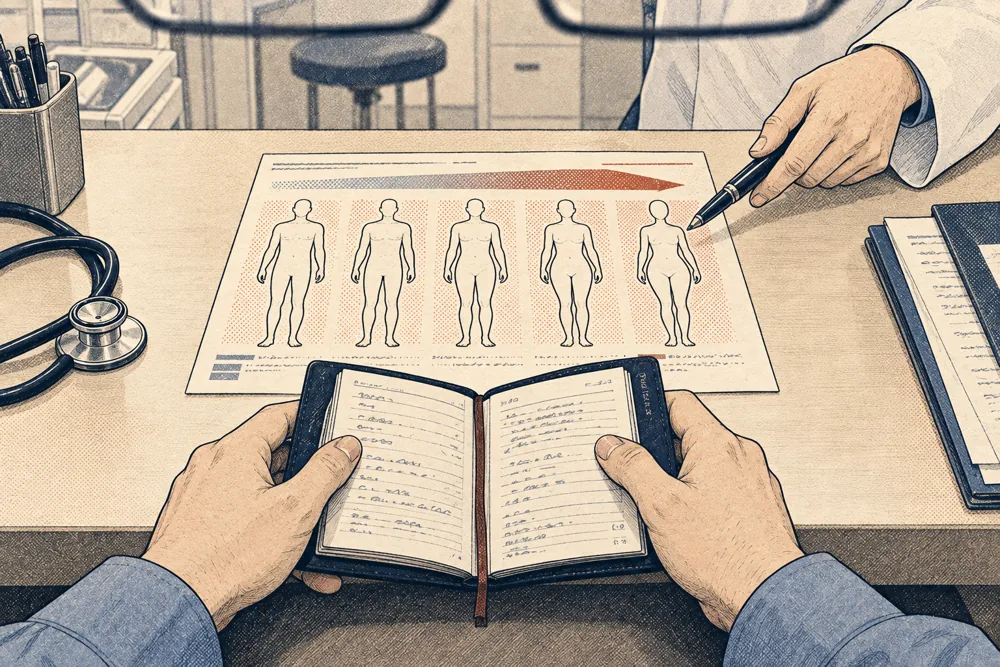
“When you say six months... that would be around September?”
Those were the first words that came out of me.
“As a general estimate, yes. But we can’t predict the exact dates of your progression today.”
I wrote September in my planner. On the same page, I had already written Catalog delivery.